
Black Skimmer - Sanibel Island, FL
Black Skimmer - Sanibel Island, FL
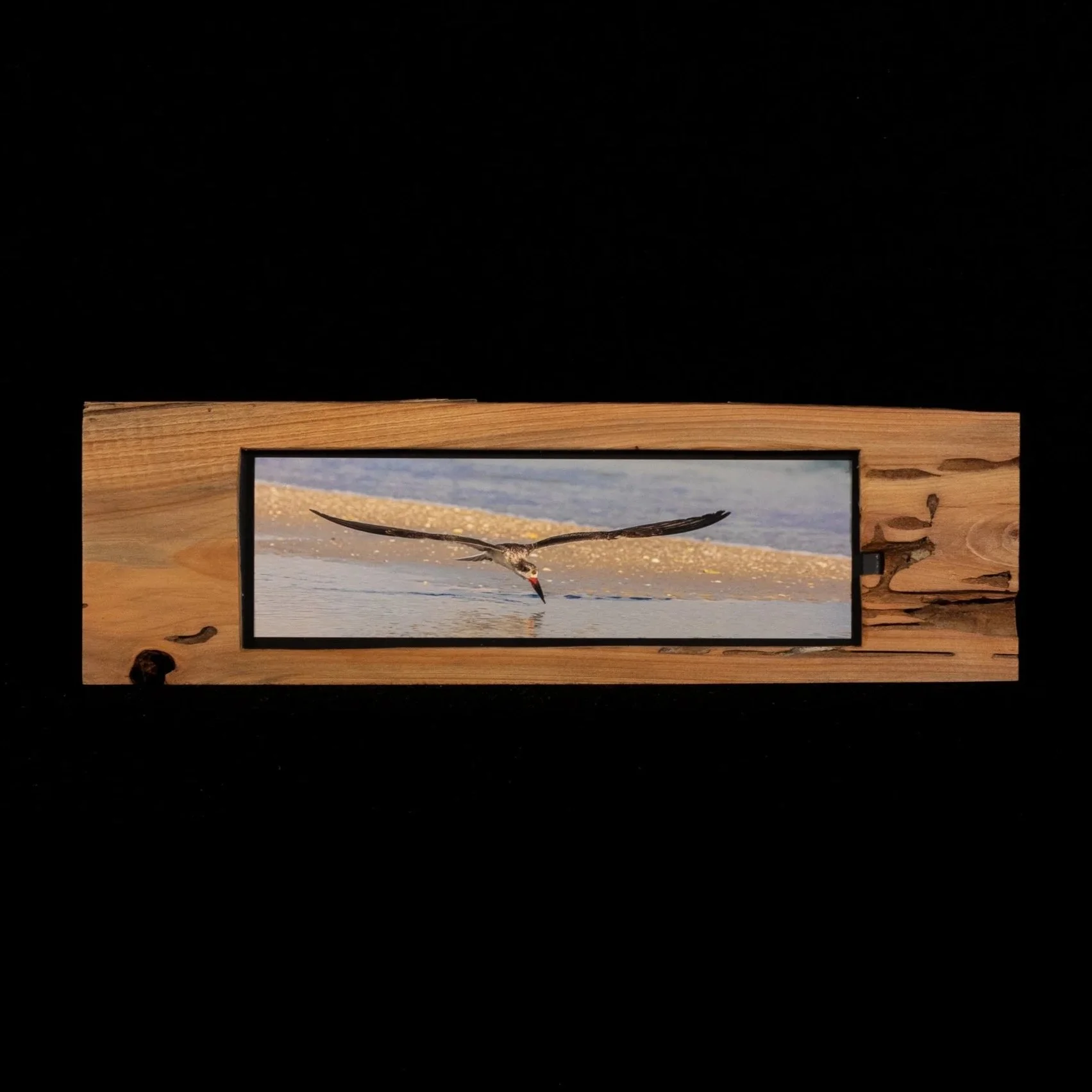
Black Skimmer (Rynchops niger), Adult
I’ve been trying to capture a skimmer as it comes directly towards me for a few years. This is as close as I’ve gotten so far! This photo was taken 9/18/20 at 4:09 pm.
WeForest Donation: $20 (What is this?)
Print Number: 1/100
Print Size: 3 × 10 in.
Total Dimensions: 5 × 16 in.
THE PHOTOGRAPH
Black Skimmer (Rynchops niger)
Found in coastal areas throughout North, Central and South America, the Black Skimmer can often be seen, what else, but skimming along the surface of the water hunting for small fish. As they fish by touch rather than sight they can be seen, if you can make them out, hunting at night as much as during the day, quite unique for many shore birds. They can be found quite often on barrier islands and more rural coasts, in small groups or sometimes larger colonies, often accompanying terns and other coastal species.
THE LOCATION
Sanibel Island, FL
Sanibel Island is in southwestern Florida, off the coast of Fort Myers. The island seems to have been created, along with Captiva just north and connected by a short bridge, around 6,000 years ago. The first humans, the Calusa Indian Nation, arrived 3,500 years later.
Sanibel, the city, was formed in 1974. Home to Bailey Tract Wildlife Preserve, The J.N. “Ding” Darling Wildlife Refuge, Bowman’s Beach Park, and Tarpon Bay, all protected areas with abundant wildlife, preserving the natural areas has been a main focus of the city since its founding. Currently, around two-thirds of the island is fully protected from development.
It is also a sanctuary for shellers. Due to its geographic location and the currents that flow around the island, immense numbers of shells wash upon the shores.
Sanibel will always be a special place for me personally. I first visited Sanibel at a mere ten weeks old. From this place, I grew up learning about nature, animals, ecosystems, climate, and our home, planet Earth. When I was a child, we routinely saw Bobcats, 12-16 foot Alligators, and Spoonbill after Spoonbill after Spoonbill. Unfortunately, once abundant wildlife is harder to see unless you know where to look. Some of this change is due to development and the destruction of the habitat, mostly though, its due to our warming climate.
We tend to not think of this in the present moment, but some of these magnificent creatures that I photograph may not be around in another twenty years, much less 100. We must appreciate them while they are still with us.
THE FRAME
Pecky Cypress (Taxodium distichum)
Known as Bald Cypress, this giant of the swamp is native to the southeastern United States. It can adapt to thrive in a wide range of soils, including very briny, salty, and water soaked areas. The pecky nature of the wood is created by a fungus that attacks the tree and eats away at its truck from the inside out. When the tree is cut down the fungus dies and leaves behind the beautiful architecture of its destruction. All of the Bald Cypress I have used in my frames has come from different parts of Louisiana.
