
Royal Tern - Sanibel Island, FL
Royal Tern - Sanibel Island, FL
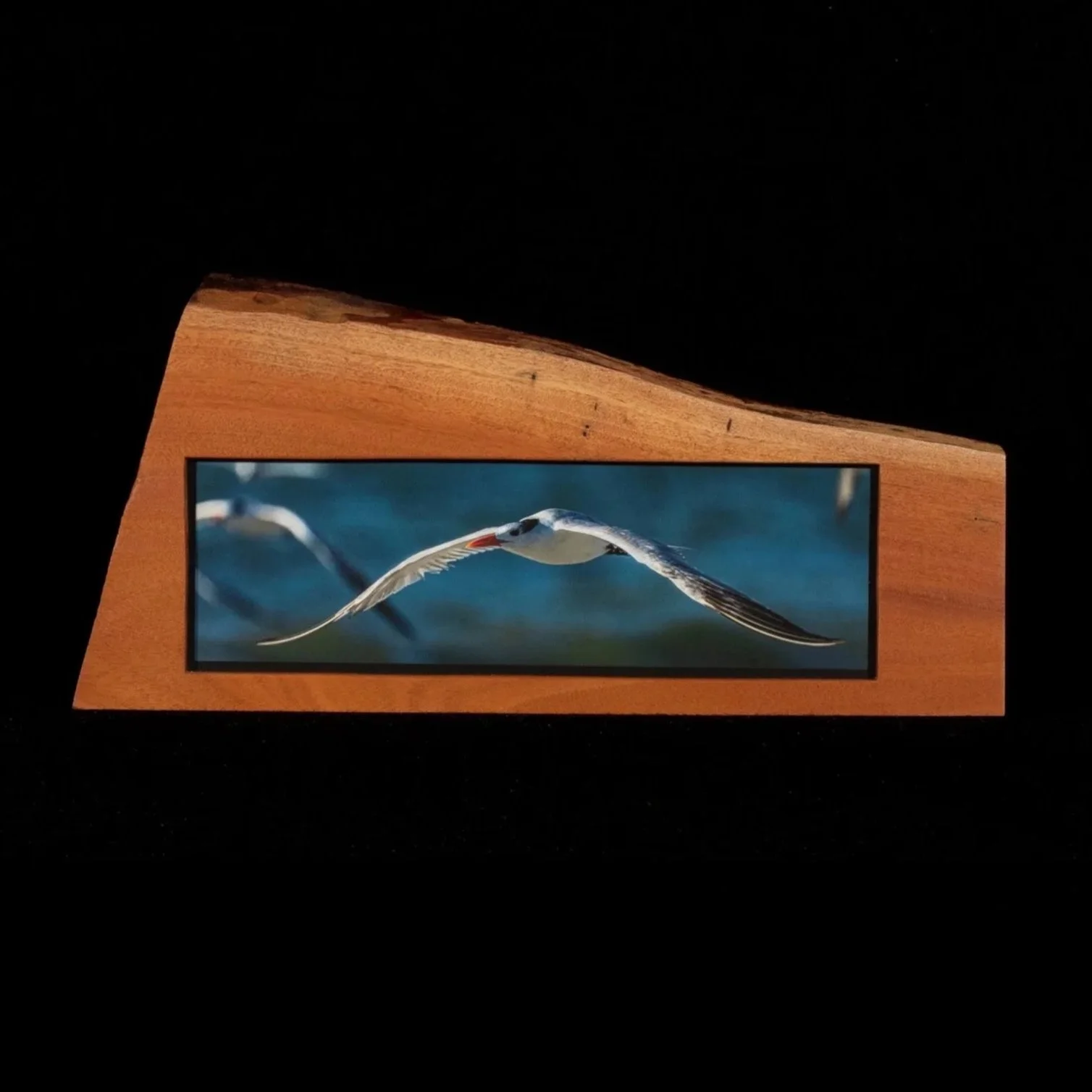
Royal Tern (Thalasseus Maximus), Adult
This was one of many dozens of Royal Terns that kept flying around me on the beach. This photo was taken 10/14/19 at 7:58 am.
WeForest Donation: $20 (What is this?)
Print Number: 1/100
Print Size: 3 × 10 in.
Total Dimensions: 7 × 14 in.
THE PHOTOGRAPH
Royal Tern (Thalasseus maximus)
Royal Terns live along warm saltwater coasts, diving for small fish in the surf. They are very friendly birds, but only with other seabirds. The Terns are only usually seen on islands that are devoid of many people or other animals. When nesting, terns gather in dense colonies. As chicks hatch, they leave their nests in the first day or so and gather together in groups called nurseries. The parents find their chicks in the raucous crowd by recognizing the calls of their offspring.
Like most terns, Royal Terns perform an act called a “dread” or “panic” in which the entire colony will rise up and silently fly over the colony site for 20 or so minutes. The reason for this behavior is totally unknown.
In the fall and winter, adult Royal Terns lose most of their black bold crown, exchanging it for a spotty white head and shaggy black hairdo similar to a typical human balding pattern.
Fun Fact: The oldest known Royal Tern was at least 30 years old.
THE LOCATION
Sanibel Island, FL
Sanibel Island is in southwestern Florida, off the coast of Fort Myers. The island seems to have been created, along with Captiva just north and connected by a short bridge, around 6,000 years ago. The first humans, the Calusa Indian Nation, arrived 3,500 years later.
Sanibel, the city, was formed in 1974. Home to Bailey Tract Wildlife Preserve, The J.N. “Ding” Darling Wildlife Refuge, Bowman’s Beach Park, and Tarpon Bay, all protected areas with abundant wildlife, preserving the natural areas has been a main focus of the city since its founding. Currently, around two-thirds of the island is fully protected from development.
It is also a sanctuary for shellers. Due to its geographic location and the currents that flow around the island, immense numbers of shells wash upon the shores.
Sanibel will always be a special place for me personally. I first visited Sanibel at a mere ten weeks old. From this place, I grew up learning about nature, animals, ecosystems, climate, and our home, planet Earth. When I was a child, we routinely saw Bobcats, 12-16 foot Alligators, and Spoonbill after Spoonbill after Spoonbill. Unfortunately, once abundant wildlife is harder to see unless you know where to look. Some of this change is due to development and the destruction of the habitat, mostly though, its due to our warming climate.
We tend to not think of this in the present moment, but some of these magnificent creatures that I photograph may not be around in another twenty years, much less 100. We must appreciate them while they are still with us.
THE FRAME
Cuban Mahogany (Swietenia mahagoni)
Cuban Mahogany is one of three species of Mahogany and it was originally the most widely used of the three. Nowadays, Honduran Mahogany is the much more prevalent wood and what most people would recognize as Mahogany. Native to the Carribbean, Cuban Mahogany’s northernmost range does include the far south of Florida, including the Keys. I happen to get all of my Cuban mahogany from a salvager in the Keys who removes the trees from construction sites before cutting it into slabs and drying it.
