
Southern Watersnake - Green Cay Wetlands, Delray Beach, FL
Southern Watersnake - Green Cay Wetlands, Delray Beach, FL
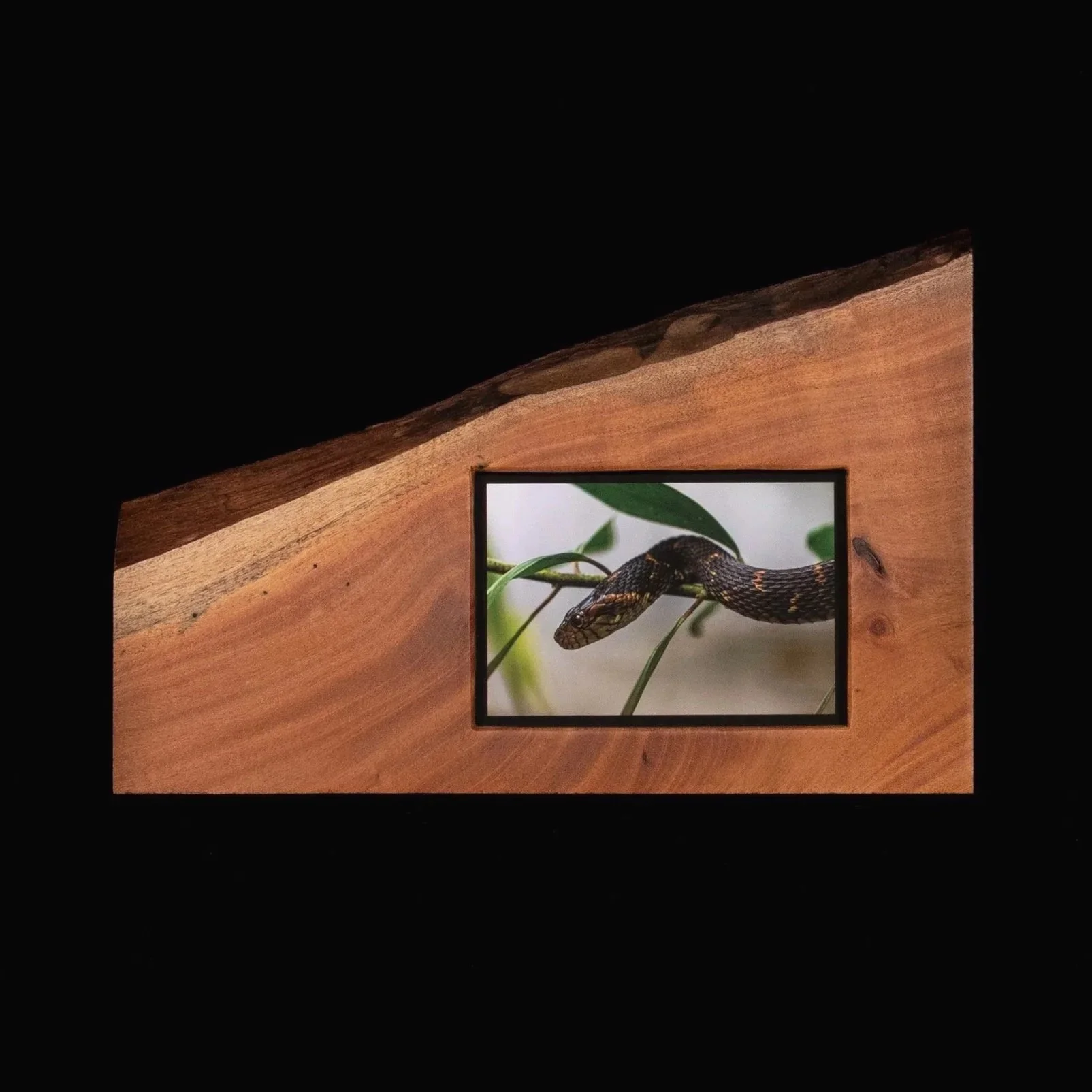
Southern Watersnake (Nerodia fasciata), Adult
A rather small snake in real life, this fellow hung out very close to the boardwalk that goes through Green Cay, allowing me to get this close-up photo of the beautiful snake. This photo was taken 3/6/22 at 5:17 pm.
WeForest Donation: $20 (What is this?)
Print Number: 1/100
Print Size: 3 × 5.5 in.
Total Dimensions: 7 × 11 in.
The Photograph
Southern Watersnake (Nerodia fasciata)
No it is not venomous. That is always the first question when it comes to snakes right? The Southern Watersnake is indeed non-venomous and is a very shy snake. It’s a good thing too as they are extremely prevalent throughout Florida and the surrounding states. Although nice to us they do have some prey that wouldn’t agree. As their name might suggest they are always found near water and that is due to their diet which almost entirely consists of frogs and fish. Furthermore, it does the majority of its hunting at night, not the most common attribute. They are also not constrictors and thus they simply bite and then swallow their food whole and alive.
The Location
Green Cay Wetlands, Boynton Beach, FL
The Green Cay Wetlands were created in 2004, converted from farmland in Boynton Beach. The park is a water reclamation center, similar to the Wakodahatchee Wetlands, naturally filtering millions of gallons of waste water each day.
A raised boardwalk through the property allows visitors to be as close or closer to the wildlife as one would be in a zoo, yet here they are free, in their natural landscape, exhibiting their wild behaviors.
Although only two miles from Wakodahatchee, there’s notable difference in the species prevalent in each location. This shows how small differences in ecosystems can have a large impacts on the species that inhabit them. Taken into a different context this is a very apt example for how great an effect climate change can have on ecosystems that are changing rapidly.
THE FRAME
Cuban Mahogany (Swietenia mahagoni)
Cuban Mahogany is one of three species of Mahogany and it was originally the most widely used of the three. Nowadays, Honduran Mahogany is the much more prevalent wood and what most people would recognize as Mahogany. Native to the Caribbean, Cuban Mahogany’s northernmost range does include the far south of Florida, including the Keys. I happen to get all of my Cuban Mahogany from a salvager in the Keys who removes the trees from construction sites before cutting it into slabs and drying it.
