
Barred Owl - Brightside Acres, WV
Barred Owl - Brightside Acres, WV
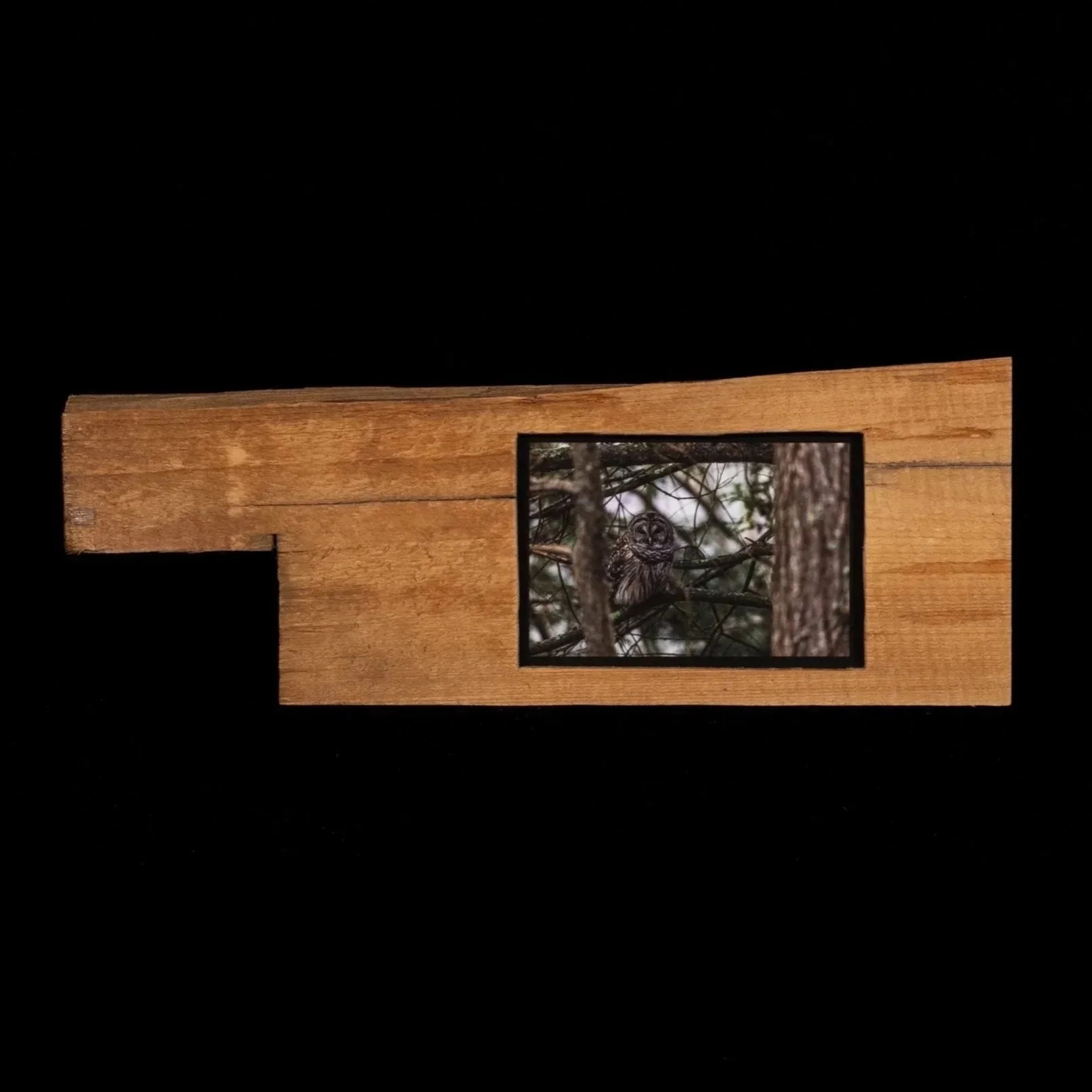
Barred Owl (Strix varia), Adult
I hear them all the time up at my family’s cabin, but rarely see them. I was riding around on the four wheeler and just happened to notice it perched off of the side of the trail. This photo was taken 11/23/20 at 3:40 pm.
WeForest Donation: $20 (What is this?)
Print Number: 1/100
Print Size: 3 × 4.5 in.
Total Dimensions: 4.5 × 13 in.
The Photograph
Barred Owl (Strix varia)
Whether or not you knew it, if you have spent any time in the forests of the eastern United States or much of Canada, and even some parts of the Northwest U.S., you have probably heard a Barred Owl. “Who cooks for you?”, they call out in the dead of night. If you happen you see one; however, count yourself lucky. They are beautiful birds, as you can see. Perfectly silent, as they expertly glide in-between trunks and branches. Homebodies, Barred Owls do not move far afield during their whole life, rarely traveling beyond five square miles from where they fledged. One circumstance that will get them to move; however, is a Great Horned Owl living in the same place. These larger birds are the number one predator of a Barred Owl, who in turn are aggressors to Spotted Owls in the Pacific Northwest.
The Location
Brightside Acres, WV
In a sense, I grew up in West Virginia, spending most of my childhood summers and holidays on my family’s land, nestled in the vast wilderness of the Monongahela National Forest. I continue to learn many things about the world from this place. Originally built as a vacation cabin, and now my mom’s permanent residence, her home is totally off grid, run by solar panels and a backup generator. Water comes from a natural spring that was used by white settlers well over two hundred years ago.
The area is especially underdeveloped, rural and secluded, and also a blackout zone for cellphone reception, due to the Greenbank Astronomy Observatory. One of the largest radio telescopes in the world, it is the primary location of the Search for Extraterrestrial Intelligence (SETI) research. Due to radio waves being so large, cellphone towers have too great of an impact on the ability for scientists to “see” through all of the noise. Therefore, cellphone towers are banned, and nearly the entire county is a blackout zone, one of the largest such areas in the country.
To be present in natural world so purely for so many years very much influences the way I see Earth. I have learned to pay attention. The unrest of the environment is ever present. Snowdrifts once towered high above the car. Now, we measure snow in inches. We used to count the number of mosquitoes we would see in a year on one hand. Now, mosquitoes are prevalent for many months. Apple trees and berry bushes produce fruit inconsistently, summers are humid, hemlock are dying, lady bird beetles infest gardens, tomatoes rot, grapes mildew, water runs in February (it should be frozen). All of these things are starkly different from when I was 10, or 100 years before that. We must all open our eyes wider, accept what is happening, and change our actions in impactful ways, rather than continue to impact our world in such detrimental ways.
THE FRAME
Pecky Cypress (Taxodium distichum)
Known as Bald Cypress, this giant of the swamp is native to the southeastern United States. It can adapt to thrive in a wide range of soils, including very briny, salty, and water soaked areas. The pecky nature of the wood is created by a fungus that attacks the tree and eats away at its truck from the inside out. When the tree is cut down the fungus dies and leaves behind the beautiful architecture of its destruction. All of the Bald Cypress I have used in my frames has come from different parts of Louisiana.
